Mind arts and psychic mastery, with madness and ego fracture as the price.
Tactical card-and-board universe
Empires Out of Time Movement matters. Range must be respected.
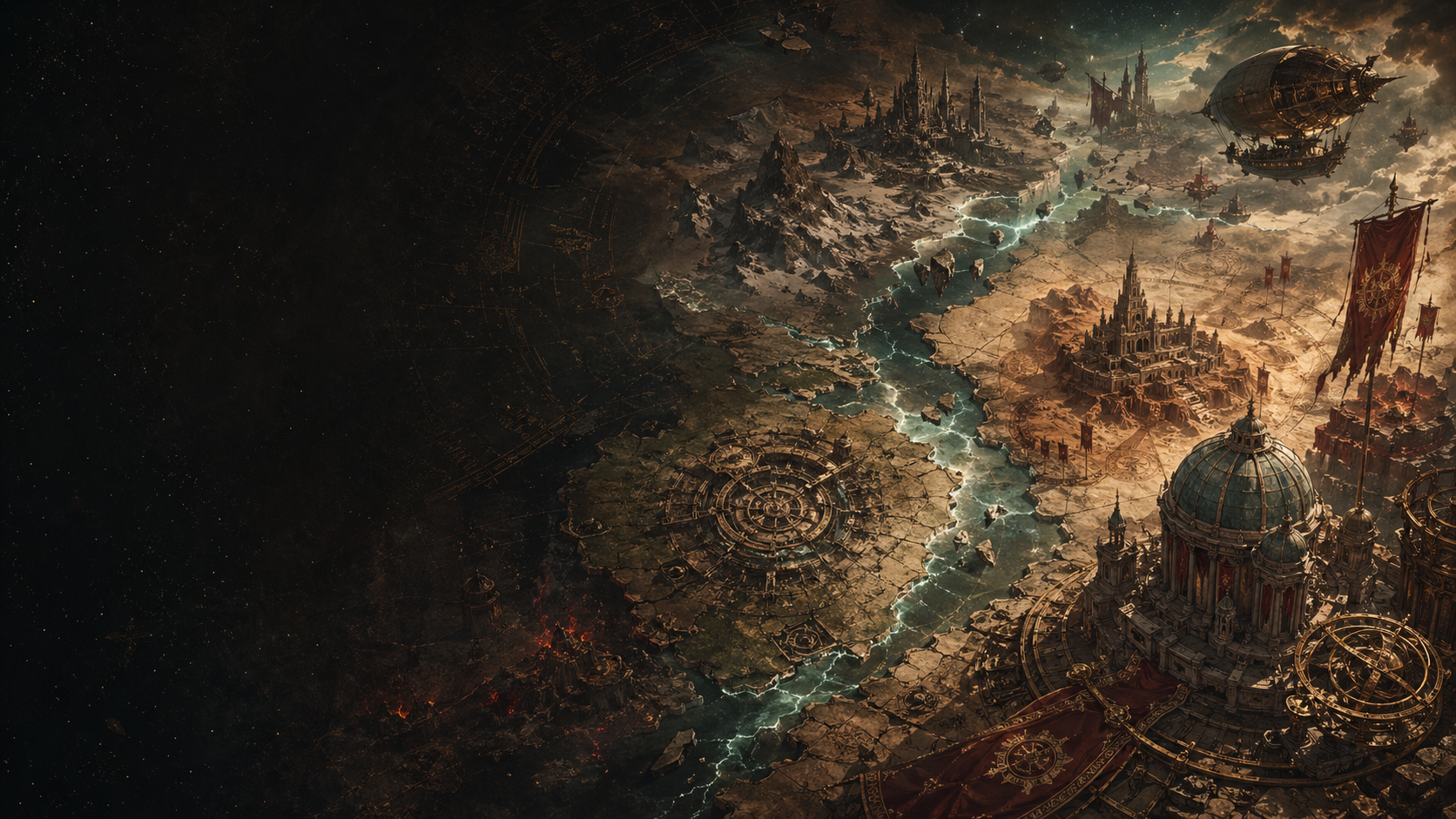
Build your deck, command the lanes, and break the enemy base on a shattered future Earth where old empires rise again with airships, artillery, knights, relic engines, and radiation-born magic.
Impact 2050
Radiant Spectrum
Steam and airships
The Book of Empires
World
A ruined Earth rebuilt from empire, myth, and industry.
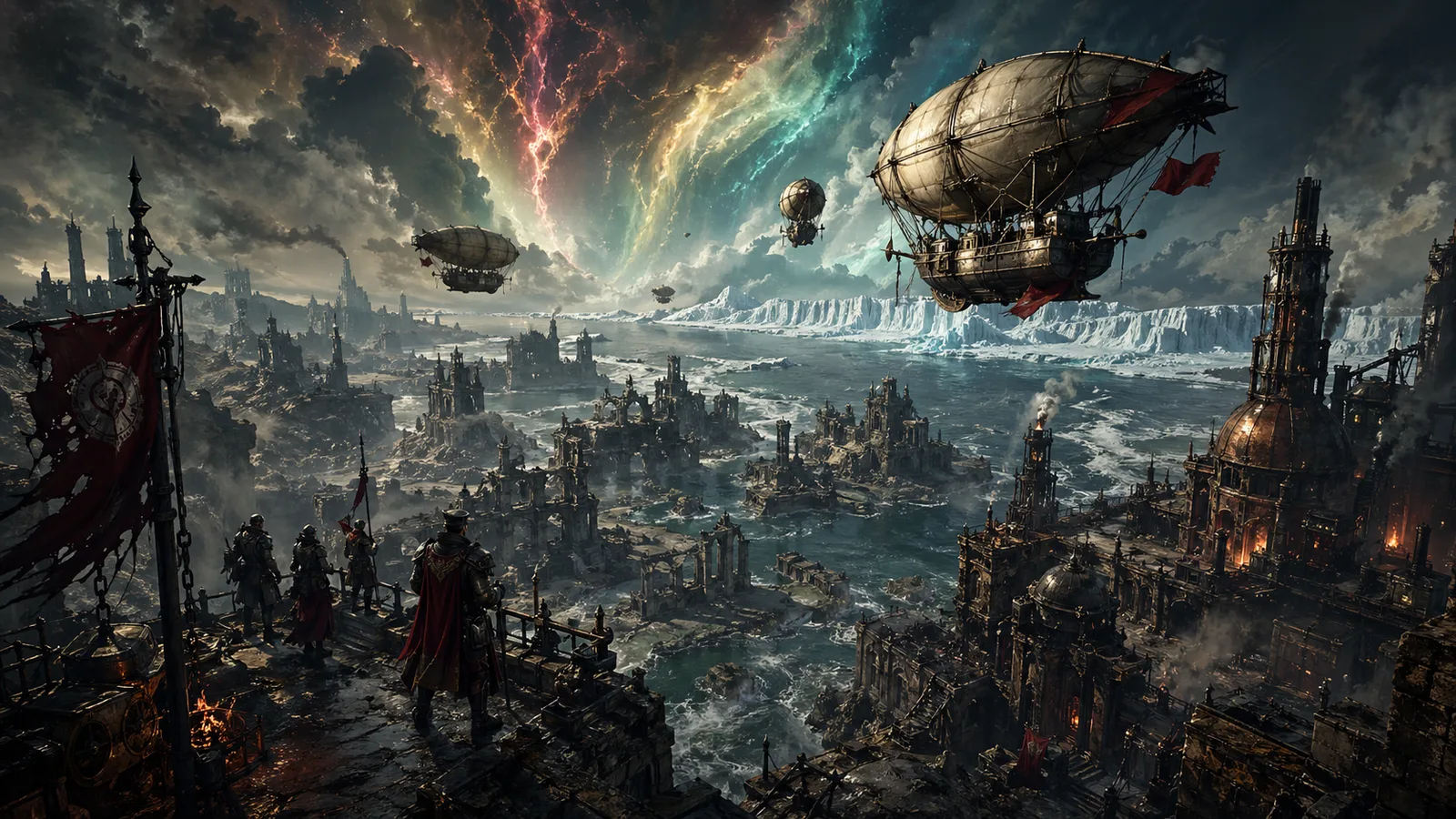
EooT begins after the 2050 Impact: flooding, atmospheric collapse, radiation saturation, geography shifts, and a long dark age. The old world is buried, drowned, frozen, mythologised, or locked behind dangerous frontiers.
By the core era, roughly Year 1800 after Impact, societies have rebuilt as mythic-industrial echoes of old powers. The Book of Empires may be relic, religion, propaganda, alien code, or simply humanity repeating old structures.
Healing and resilience that can harden into rigidity and stagnation.
Speed, reflexes, mobility, and unstable kinetic backlash.
Geomancy and beast traits balanced against feral takeover.
Leadership, purification, and moral injury when belief curdles.
Necromancy, entropy, and shadow arts that invite exile and corruption.
Empires
Mythic nations, industrial contradictions, living tactics.
Canon status: core faction
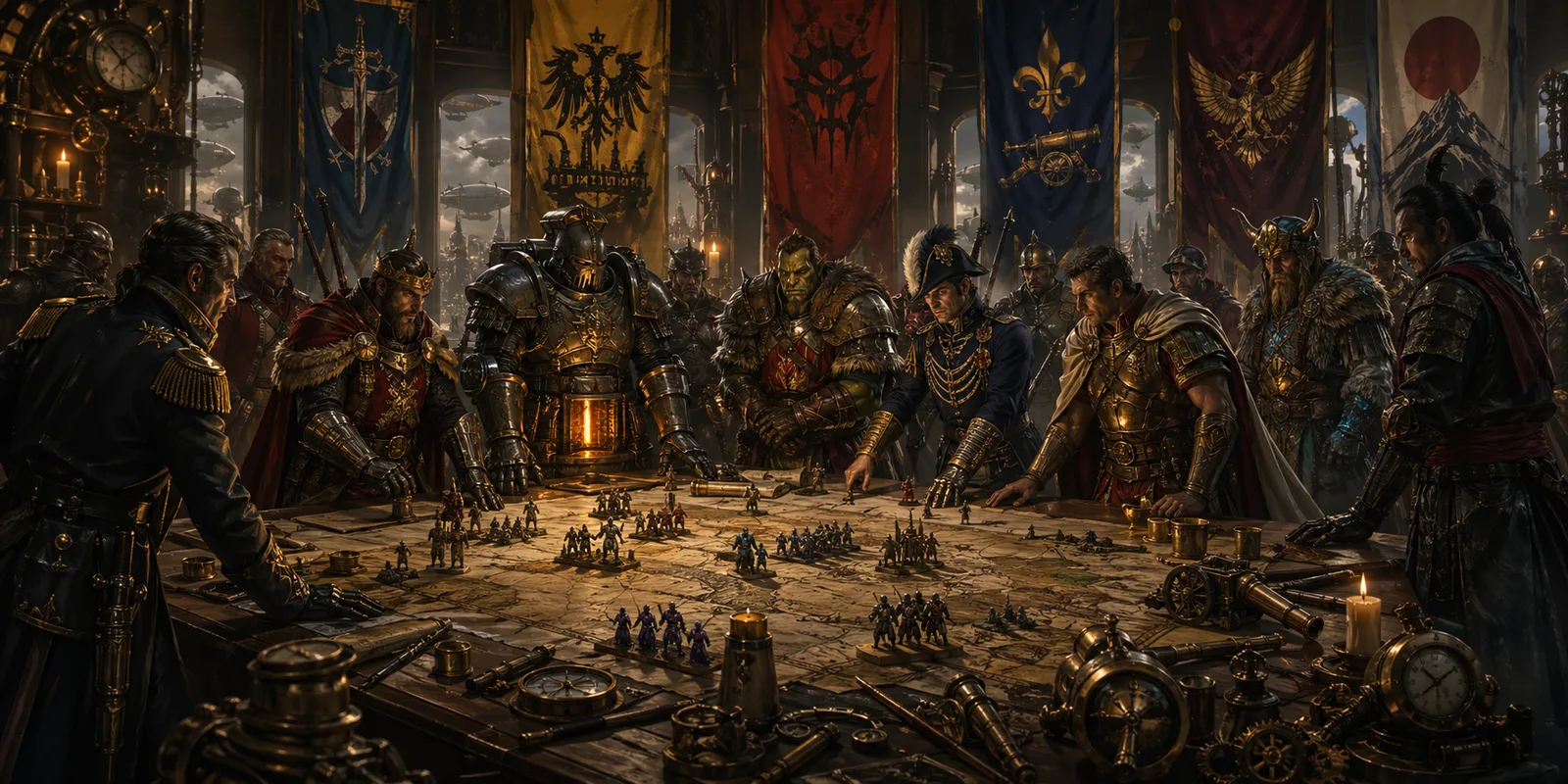
British Empire / Camelot
Arthurian myth and industrial discipline meet in rain-black London rings, Merlin Knight orders, brass war tables, airships, class tension, and oath-bound officers.
Game feel
Balanced formations, command buffs, flexible lanes
Signature
Merlin Knights and ring-city London
Tension
Duty, empire, sacrifice, and class pressure
Timeline
The calendar counts from the Impact.
Survival Age
The first century after the sky broke.
Scavengers, raiders, mutation, and the first Radiant awakenings define a planet trying to stay alive.
How to Play
Destroy the enemy base by controlling space, range, and resources.
Need the full tabletop reference? Open the complete EooT rulebook PDF.
Break the base.
Each player protects a base with 20 HP and 5 DEF. Attack it with units on the battlefield, reduce it to 0 HP, and win the game.
Open Full Rulebook PDF- Base
- 20 HP / 5 DEF
- Deck
- 32 cards
- Hand
- Draw to 7
- Income
- 5 Coins / 5 Gems
16 Units. 16 Gems.
Unit cards cost Coins and use MOV, DMG, DEF, HP, and RNG. Gem cards cost Gems and come as Upgrades, Actions, Economic cards, and Traps.
Rules video
EooT TCG Tutorial Part 1
Watch the first guided rules walkthrough for setup, table flow, movement, range, resources, and base-breaking combat.
Open Video
Player 1 side
Base
1
2
3
4
5
Player 2 side
Base
Shuffle, draw 7, start with resources.
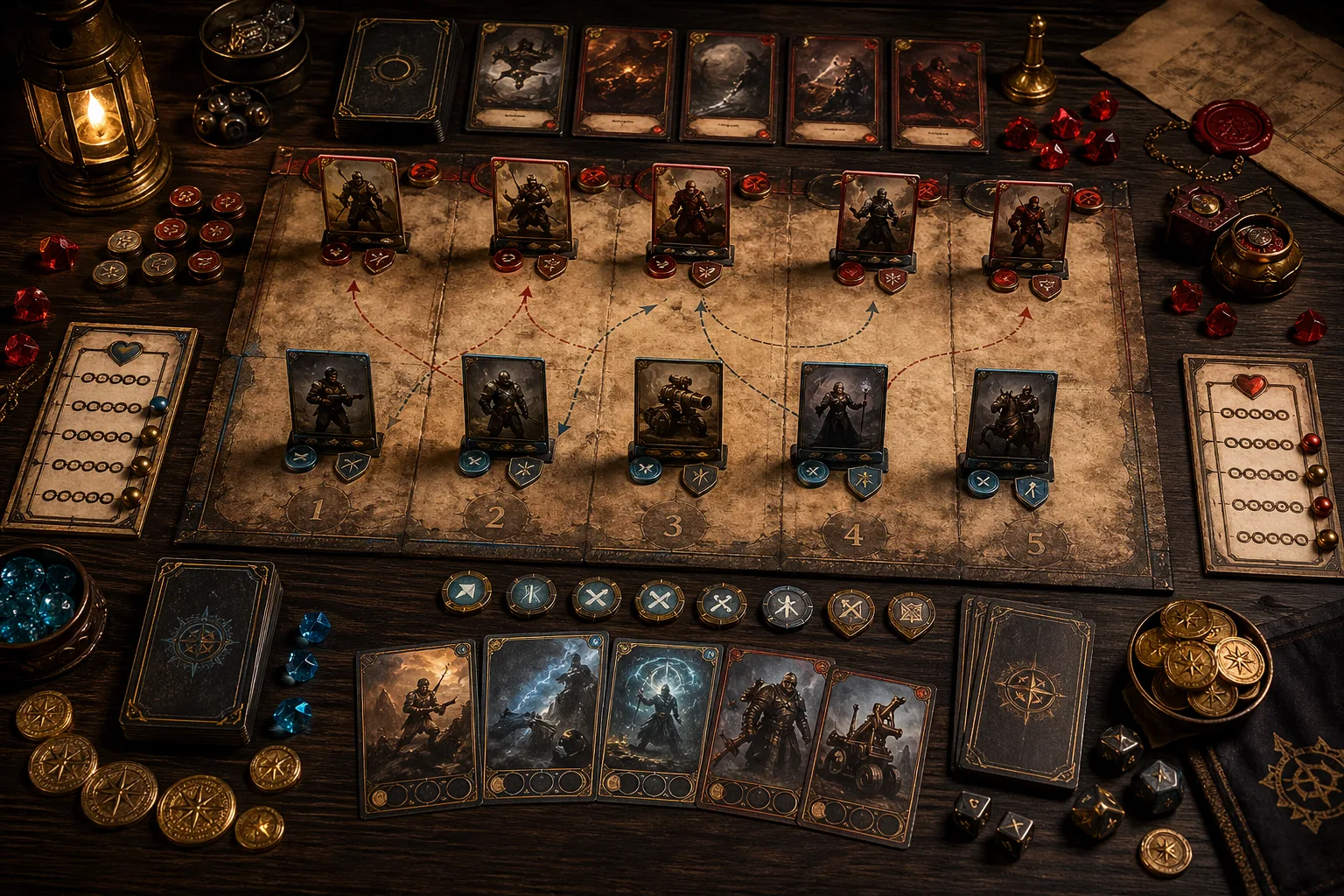
Place five position cards in order from 1 to 5. Shuffle well, draw a 7-card hand, start with 5 Coins and 5 Gems, and choose the first player. The first player cannot attack on turn one.
Five Units and five Gems.
A player can have up to five units and five gem cards on the battlefield. Only one unit from either side can occupy the same position in the card game.
Draw and place.
At the start of your turn, draw back up to 7 cards. Play the Units and Gems you can afford from your hand onto the field.
Move and attack in either order.
Units can attack then move, or move then attack. A unit attacks once per turn, then you end your turn after resolving the units you want to use.
0 RNG is straight ahead.
0 RNG can attack only the opposing unit in the same position. 1 RNG reaches one position to either side, so position 3 can hit positions 2, 3, and 4.
MOV shifts side to side.
1 MOV lets a unit move one position across. Units can move at the same time to swap positions and set up range or blocking.
HP lost = DMG - DEF.
Reduce damage by the defender's DEF. Discard a unit when its HP reaches 0.
Blocks still matter.
If no opposing unit is directly in front, a unit can attack the base. A defender in movement range may move to block and take the damage instead.
Game Modes
The same cards scale from quick starts to board battles.
Tactical 5-position play
The main card game uses five positions, resource income each turn, unit movement, range, Gems, blocking, and base attacks.
Simplified first games
For early games, ignore movement, range, tags, and passive abilities. Sell cards from hand for their Coin or Gem cost to keep the game moving.
Free-for-all and teams
Each player gets their own position line. Free-for-all players take individual turns, while 2v2 teams place and attack together.
25 tiles, objectives, forests
Move on a 25-tile board with 9 objectives, 4 forest blockers, and 12 empty spaces. Capture objectives for income and fight toward the enemy starting objective to attack their base.
Tokens and larger wars
Built for 3-4 players. Unit cards sit beside the board while their icons move from corner castles, with up to 10 units in play.
Stories
The war is bigger than the table.
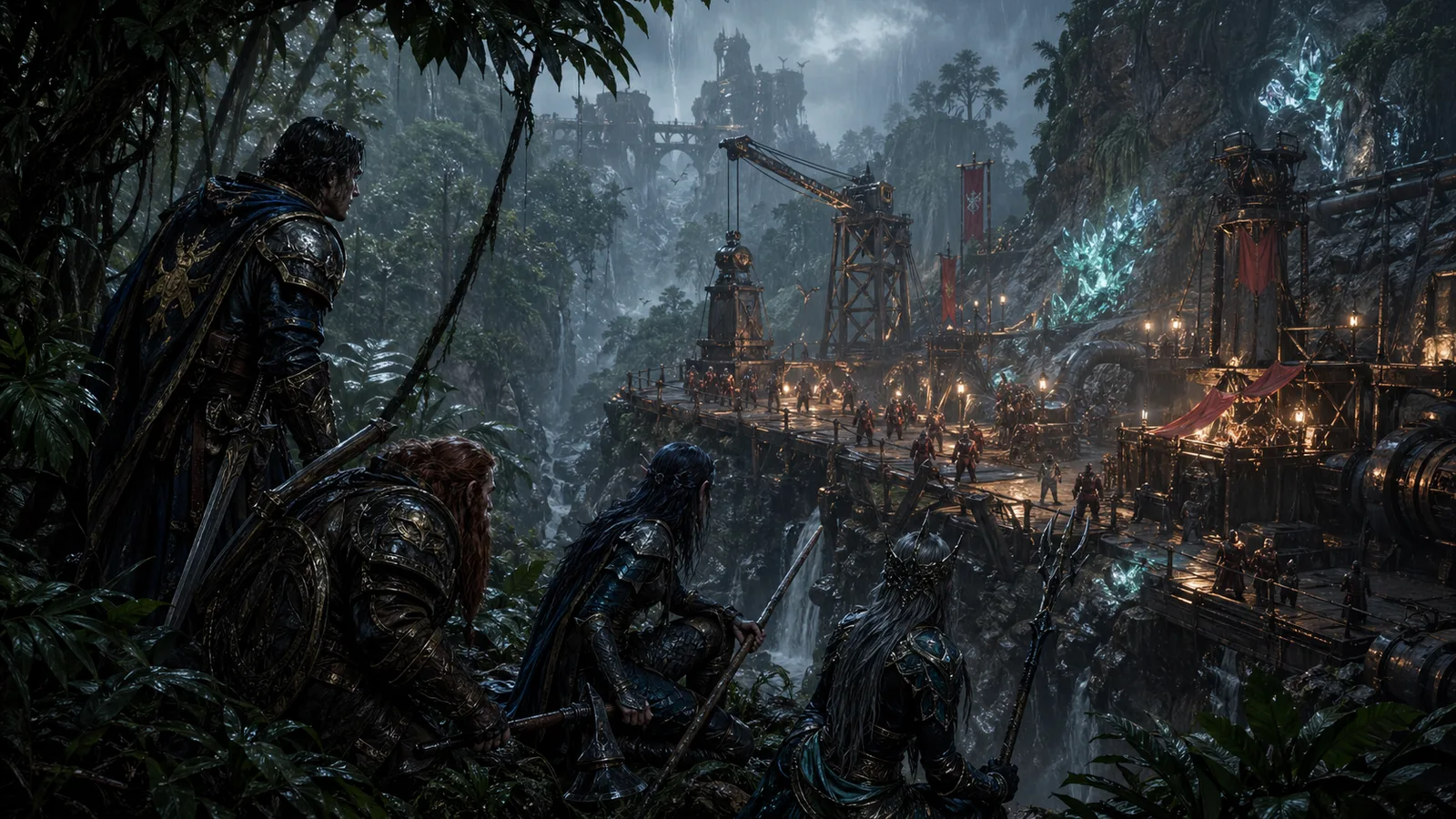
The Storm Gathers
Britain/Camelot, court politics, Merlin Knights, and the first moves toward a world-spanning industrial war.
Lancelot and Gawain
A human Merlin Knight and a dwarf knight aid sea-elves against illegal Roman corporate mining.
Gangs and Detective Dice
Slum ambition, Rosewood Corp armour, dock gangs, illegal weapons, and hybrid animal trafficking.
Codex
Build the archive without solving every mystery.
Track faction lore, Radiant bands, unresolved rules, starter decks, playtest scars, and campaign chronicles while keeping the Book of Empires disputed and dangerous.